
Entities: people, companies, topics
What they are
Named things the AI pulled out of your content: people, companies, topics, concepts, locations, products, plus a catch-all "other". They're what makes the Memory more than a pile of dots: two meetings that both mention "Acme" become connected without anyone tagging anything.
Where you see them
- The Memory's PEOPLE / COMPANIES / TOPICS / CONCEPTS / LOCATIONS / PRODUCTS / ENTITIES sectors.
- ⌘K results (Memory beta must be on), showing kind and mention count.
- The Company picker on tasks and projects: the company list there is exactly the
companyentities from the graph, which is why a company created there later shows up in the map.
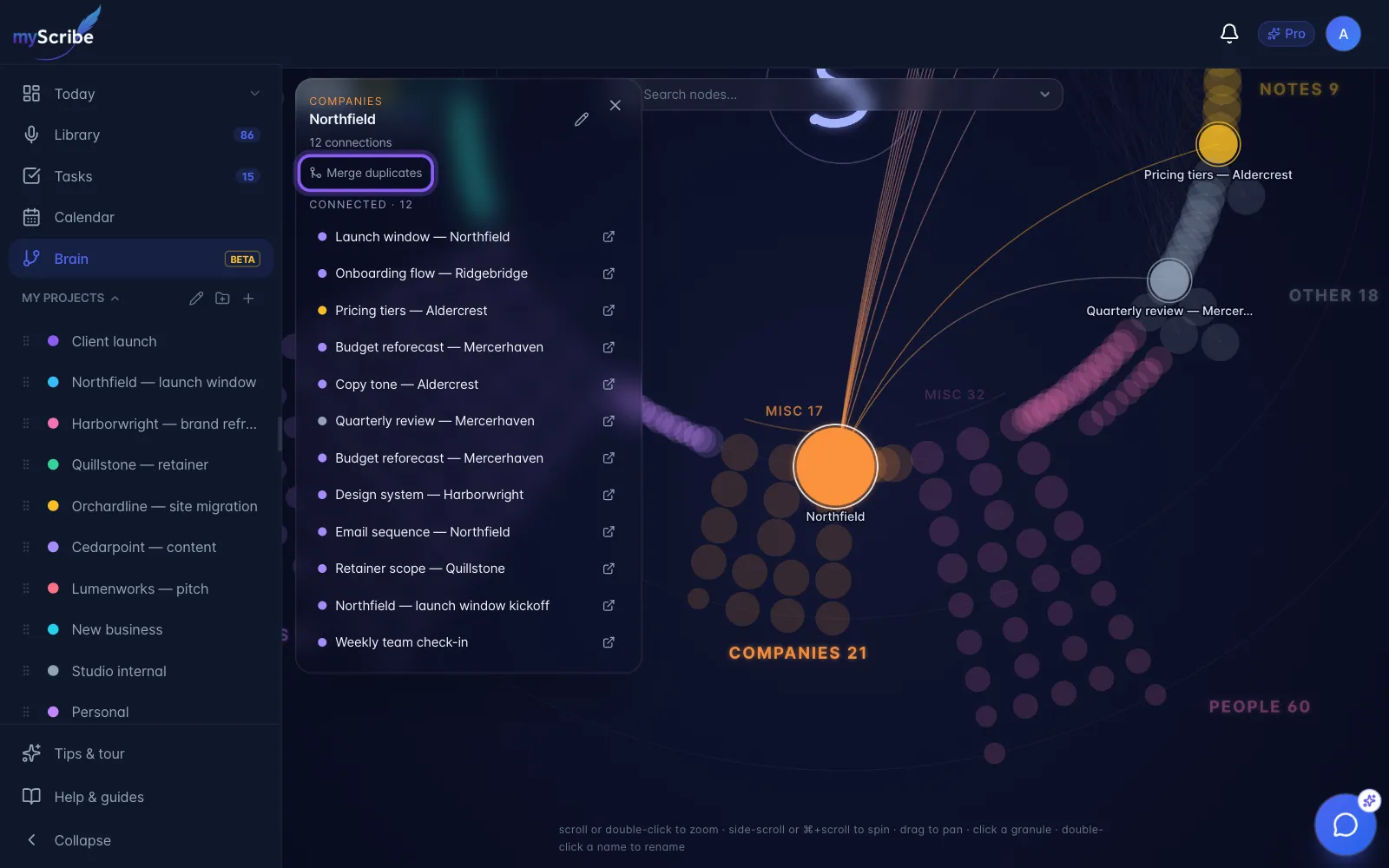
There is no dedicated entities screen and no list view. You can, however, fix an entity from inside the Memory: click its dot and use the pencil to rename it, or Merge duplicates to fold other spellings of the same person or company into it. There is still no way to delete a single entity outright.
Where they come from
Entity extraction runs automatically, in the background, a minute or two after content is processed. It happens for:
- Recordings and uploads, once transcription finishes.
- Meetings captured by the meeting bot, once the transcript is ready.
- Saved links / articles / YouTube videos (Library → Import → Save a link).
- Uploaded PDFs (Library → Import → PDF).
It does not happen for:
- Pasted transcripts / notes (Library → Import → Paste text). These get a summary and tasks, but never entities and never auto-tags. This is a real gap and a likely support question.
Company entities are additionally created by the project/task side of the app: naming a folder after a client, or picking a company on a task, mints the same kind of entity.
What the extraction actually does
The AI reads up to roughly 60,000 characters of the content and returns at most 20 entities plus 2–4 tags. Before it runs, it's shown your workspace's existing entity names and your folder and project names, and told to reuse an existing name rather than invent a variant. So "Camino LLC" gets folded into the existing "Camino" rather than becoming a second company, and a recording that never says the client's name out loud can still be linked to the client because the folder it lives in is named after them.
It also deliberately shortens names: acronyms stay acronyms ("SPCC", not "Spill Prevention Control and Countermeasure Plan"), broad themes stay broad ("oil and gas"). The longer variants are kept as hidden aliases so future matching still works.
Mention count is the number of separate pieces of content an entity appears in, not how many times it was said inside one recording.
Limits and gotchas
- Runs once per item. Entity extraction is skipped if the item already has tags. It won't re-run when you edit a title or fix speaker names.
- 20 entities per item, maximum, and only the first ~60,000 characters are read. A three-hour meeting is not fully covered.
- Misspellings and duplicates are fixable, mis-links aren't. Open the Memory, click the entity's dot, and either rename it with the pencil or use Merge duplicates to fold other spellings into it: their mentions, links and company assignments move across, and the old spellings survive as aliases so future extractions still find their way home. What you still can't do is delete a single entity, or move one off a recording it shouldn't be on.
- People here are not speakers. Naming speakers on a recording has no effect on the PEOPLE sector.
- Not instant. Extraction runs in the background after processing; a brand-new recording will be a dot with no entities for a little while, and the Memory needs a reload (or "Reload data") to show them.
- Extraction can fail silently. If the AI call fails, the item simply ends up with no entities and no tags: there's no error surfaced to the user. The visible symptom is "some of my recordings have tags and some don't".
- The AI is inconsistent with generic terms. It's explicitly told to skip things like "the company" and overly broad concepts, so genuinely important-but-generic topics sometimes don't get extracted.